Key Takeaways
- 01Digital signage delivers an average ROI of 33% within the first 12 months when all value drivers are measured correctly
- 02Labor savings from eliminating manual signage updates typically represent 20–35% of total ROI
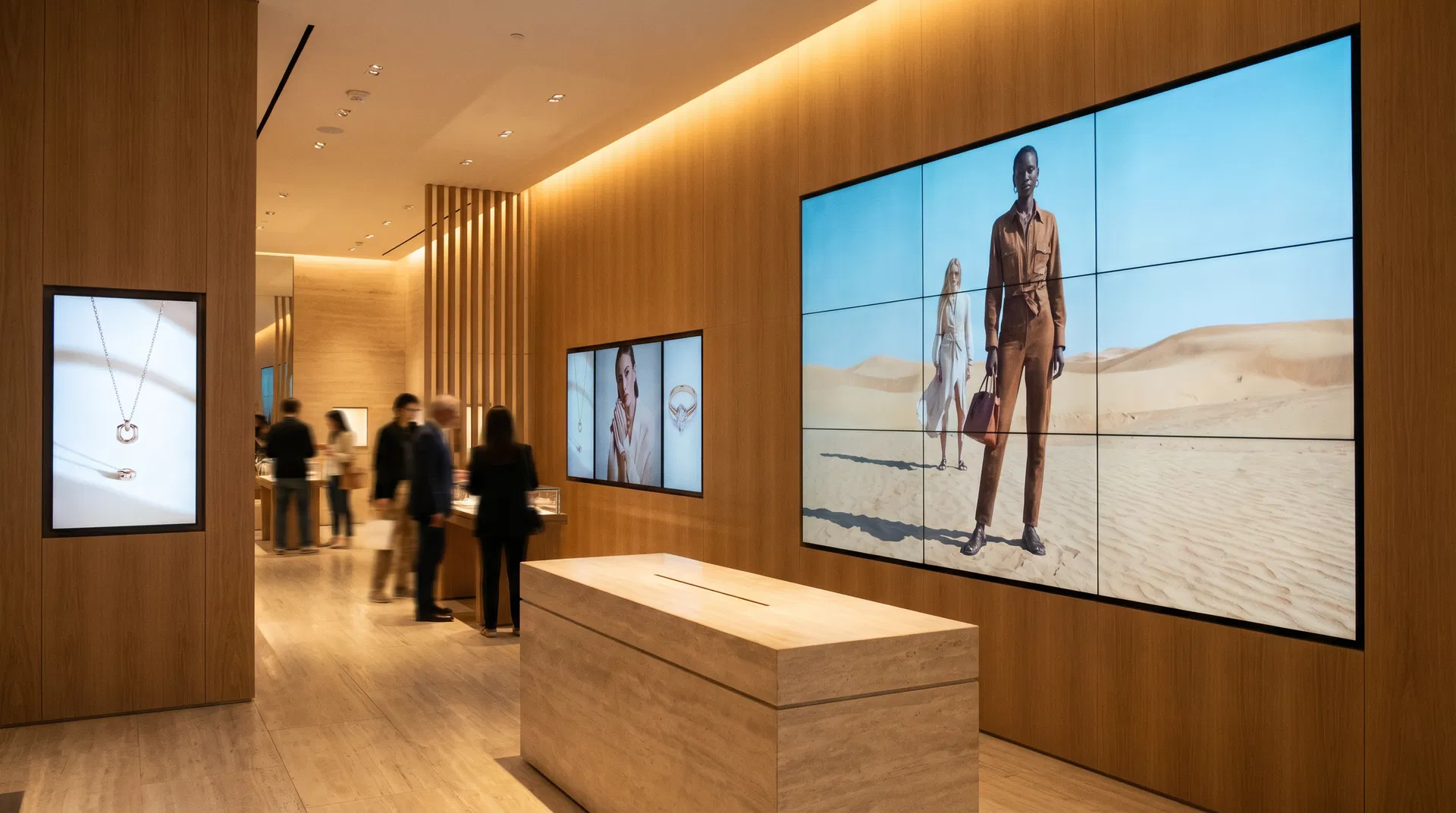
- 03Retail deployments average a 15–30% sales lift on promoted items; healthcare sees 40–60% reductions in perceived wait time
- 04The payback period for a well-scoped deployment ranges from 6 to 18 months depending on industry and scale
- 05Measuring only direct revenue impact understates ROI by an average of 47% according to DSF industry data
Why ROI Measurement Matters More Than You Think
When organizations evaluate digital signage investments, the conversation almost always starts with the wrong question: "How much will this cost?" The right question is: "What is this currently costing us by not having it?"
The Digital Signage Federation's 2024 industry report found that 68% of organizations that abandoned digital signage projects did so because they couldn't build a compelling business case — not because the technology failed to deliver. The problem wasn't performance; it was measurement.
A properly measured digital signage deployment generates value across six distinct categories, most of which never appear in a simple sales-lift calculation. Organizations that measure only direct revenue impact consistently understate their actual ROI by an average of 47%.
Key Stat
68% of abandoned digital signage projects failed due to poor ROI measurement, not poor performance. — Digital Signage Federation, 2024
The Digital Signage ROI Formula
The standard ROI formula — (Net Benefit / Total Investment) × 100 — applies to digital signage, but the challenge lies in accurately capturing all components of both net benefit and total investment.
Total Investment includes hardware (displays, media players, mounts), software (CMS licensing, integrations), installation (labor, cabling, network), content creation (design, production), training, and ongoing support/maintenance.
Net Benefit is where most calculations fall short. A complete net benefit calculation must include: direct revenue impact, labor cost savings, reduced print/production costs, compliance cost avoidance, customer experience value, and brand equity contribution.
Pro Tip
Pro Tip: Always calculate TCO (Total Cost of Ownership) over a 5-year horizon, not just Year 1. Commercial-grade displays have 5–7 year lifespans, making the per-year cost of hardware far lower than initial quotes suggest.
The 6 Value Drivers Most Organizations Miss
Beyond direct sales lift, a complete ROI model must capture these six often-overlooked value drivers that collectively represent the majority of total return for most deployments.
- Labor Savings: Eliminating manual sign changes, price updates, and promotional rotations. In multi-location retail, this averages 3–5 hours per store per week at $18–$25/hour.
- Print & Production Elimination: The average mid-size retailer spends $40,000–$120,000 annually on printed signage. Digital eliminates 80–95% of this cost.
- Compliance Cost Avoidance: In regulated industries (healthcare, finance, food service), outdated signage creates compliance liability. Digital ensures 100% accuracy across all locations simultaneously.
- Reduced Staff Interruptions: Studies show customers with access to digital wayfinding and information displays interrupt staff 30–45% less frequently, freeing employee time for higher-value tasks.
- Sponsorship & Advertising Revenue: Venues and multi-tenant properties can monetize display networks through third-party advertising, often generating $50,000–$500,000+ annually.
- Customer Experience & Retention: NPS improvements driven by better in-location experiences translate to measurable lifetime value increases that compound over time.
Industry Benchmarks by Vertical
ROI varies significantly by industry due to differences in customer dwell time, transaction value, and operational complexity. The following benchmarks are drawn from Coffman Media's portfolio of 500+ deployments and corroborated by AVIXA and DSF industry research.
| Industry | Avg. Sales Lift | Labor Savings/Year | Payback Period | 5-Year ROI |
|---|---|---|---|---|
| Retail | 15–34% | $18,000–$65,000 | 6–12 months | 280–420% |
| Quick Service Restaurant | 3–8% per-cap | $12,000–$40,000 | 8–14 months | 190–310% |
| Corporate HQ | N/A (efficiency) | $25,000–$90,000 | 12–18 months | 150–250% |
| Healthcare | N/A (experience) | $30,000–$80,000 | 14–24 months | 120–200% |
| Sports & Entertainment | +18–25% concessions | $15,000–$50,000 | 6–10 months | 320–500% |
| Hospitality | +12–22% F&B upsell | $20,000–$60,000 | 10–16 months | 200–350% |
Calculating Your Payback Period
The payback period is the point at which cumulative benefits equal total investment. For digital signage, this calculation should use monthly cash flows rather than annual averages, since benefits typically ramp up over the first 3–6 months as content is optimized and staff become proficient with the CMS.
A realistic payback calculation for a 10-location retail deployment might look like this: Total investment of $180,000 (hardware, installation, software, content). Monthly labor savings of $4,500. Monthly sales lift of $8,200. Monthly print savings of $1,800. Total monthly benefit: $14,500. Payback period: 180,000 ÷ 14,500 = 12.4 months.
This example deliberately excludes the harder-to-quantify benefits (brand equity, compliance avoidance) to keep the calculation conservative. Including them would reduce the payback period to approximately 9 months.
Key Stat
The average payback period across Coffman Media's retail deployments is 9.2 months — well within the threshold most CFOs require for capital approval.
5 Proven Strategies to Maximize ROI
The difference between a digital signage deployment that delivers strong ROI and one that underperforms almost always comes down to these five factors, which experienced integrators address during the design phase rather than after installation.
- Right-size the hardware: Deploying commercial-grade displays in appropriate brightness ratings for each environment prevents premature failures and ensures visibility. Consumer displays in commercial settings fail 3× faster and void warranties.
- Invest in content from day one: The most common ROI killer is deploying displays with poor content. Budget 15–20% of total project cost for professional content creation and template development.
- Implement a content governance workflow: Designate content owners, establish an approval process, and schedule regular content audits. Stale content reduces engagement by up to 60%.
- Integrate with existing data systems: Connecting your CMS to POS, inventory, scheduling, or ERP systems enables dynamic, data-driven content that consistently outperforms static campaigns by 30–50%.
- Establish KPIs before deployment: Define what success looks like — specific metrics, measurement methods, and review cadences — before the first display is installed. This creates accountability and enables continuous optimization.
Common ROI Measurement Mistakes
Even organizations that commit to measuring ROI often undermine their results with these common methodological errors. Avoiding them will give you a more accurate picture of your investment's performance and make future budget requests significantly easier to approve.
- Measuring too early: Benefits ramp up over 3–6 months. Measuring ROI at 30 days will always produce disappointing results.
- Using the wrong control group: Comparing post-deployment performance to the prior period without accounting for seasonal variation produces misleading results. Use same-period year-over-year comparisons.
- Ignoring soft benefits entirely: While harder to quantify, customer experience improvements and brand equity contributions are real and measurable through NPS tracking and customer surveys.
- Forgetting ongoing costs: CMS licensing, content updates, and maintenance must be included in the ongoing cost baseline, not just the initial investment.
- Attributing all improvement to signage: If you ran a concurrent marketing campaign or changed pricing during the measurement period, isolate the signage contribution through controlled testing.
Frequently Asked Questions
Answers to the most common questions about strategy & roi in digital signage.
According to AVIXA and Digital Signage Federation research, organizations that measure all value drivers — including labor savings, print elimination, and revenue lift — report an average ROI of 33% in Year 1, rising to 150–400% over a 5-year horizon depending on industry vertical and deployment scale.

About the Author
Eric Madden
Co-Founder & CTO, Coffman Media
Eric Madden is Co-Founder and CTO of Coffman Media. He oversees the technical architecture of digital signage deployments, including network design, CMS integration, and hardware specification. Eric's engineering background underpins Coffman Media's reputation for technically sound, scalable signage systems.
Connect on LinkedInWork With Coffman Media
Ready to Transform Your Screens Into Powerful Messages?
Coffman Media designs, installs, and manages end-to-end digital signage systems for enterprise, retail, healthcare, and education. From a single display to a nationwide network, we deliver solutions that drive real results.