Key Takeaways
- 01Digital signage at fuel stations increases impulse purchases by 40% — pump-top displays are the highest-ROI touchpoint in the c-store customer journey
- 02Approximately 80% of shoppers are influenced to enter a store after seeing digital signage at the forecourt
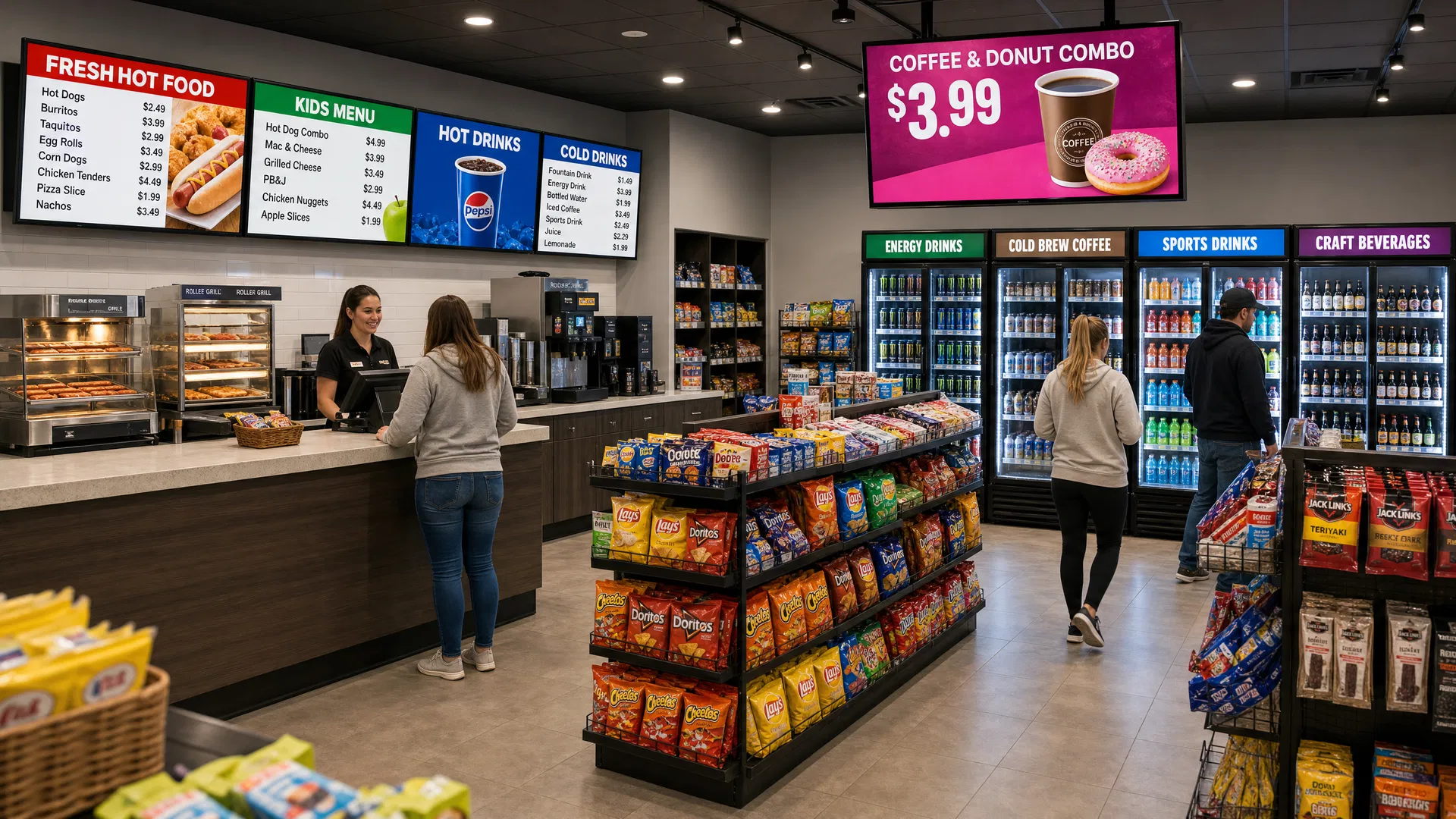
- 03Digital menu boards for c-store foodservice increase average transaction value and make menu updates instant — critical for daypart pricing and limited-time offers
- 04Cloud-based CMS platforms enable centralized content management for chains of 50–500+ locations with location-specific overrides for regional pricing and promotions
- 05POS integration with Verifone, Gilbarco, and PDI systems allows digital signage to trigger content based on transaction data and loyalty program activity
The Forecourt Opportunity: Converting Fuel Customers to In-Store Buyers
The economics of convenience retail have shifted dramatically over the past decade. Fuel margins have compressed while foodservice and prepared food margins have expanded. The strategic imperative for c-store operators is clear: get more fuel customers into the store. The challenge is that most fuel customers have no intention of going inside — they're in a transactional mindset, focused on completing a task and moving on.
Digital signage changes this dynamic. Research shows that approximately 80% of shoppers are influenced to enter a store after seeing digital signage, and fuel station digital signage increases impulse purchases by 40%. The pump is a captive audience moment — customers are standing still for 3–5 minutes with nothing to do but watch a screen. That's a communication opportunity that static decals and printed pump-topper cards cannot match.
The key insight is that pump-top digital displays don't just advertise — they create a reason to go inside. A display showing a hot coffee promotion, a limited-time foodservice item, or a loyalty program offer gives the customer a specific, time-sensitive reason to walk through the door. The conversion from fuel-only to fuel-plus-in-store purchase is the most valuable behavioral change a c-store operator can drive, and digital signage at the pump is the most effective tool available to drive it.
Key Stat
Digital signage at fuel stations increases impulse purchases by 40%. Approximately 80% of shoppers are influenced to enter a store after seeing digital signage at the forecourt. — Advision / MarketsandMarkets research
Pump-Top Displays: Content Strategy and Hardware
Pump-top displays are weatherproof digital screens mounted on or near fuel dispensers. They operate in one of the most demanding outdoor environments for digital signage: direct sunlight, temperature extremes from -20°F to 120°F, rain, wind, and the vibration of an active fuel dispenser. Hardware specifications must match the environment.
For pump-top displays, the minimum brightness specification is 2,500 nits — the threshold for readability in direct sunlight. High-end pump-top displays reach 3,000–5,000 nits. Operating temperature range should cover at minimum -20°C to 60°C. Weatherproofing should meet IP65 or better. Display size is typically 10–21 inches diagonal, sized to be visible from the driver's seat of a vehicle at the adjacent pump.
Content strategy for pump-top displays should be built around the 3–5 minute dwell time and the specific conversion goal: getting the customer inside. Effective pump-top content includes: featured foodservice items with price and a clear call to action, loyalty program promotions, limited-time offers with countdown urgency, and fuel-to-store cross-promotions.
Content should be short — 5–10 seconds per message — and designed for outdoor viewing: large text, high contrast, minimal copy. The customer is not going to read a paragraph at the pump. They will read a headline and a price.
Pro Tip
Pump-Top Content Rule: Every piece of content on a pump-top display should have one clear call to action and one clear benefit. If you can't state the offer in six words or less, simplify it. 'Fresh pizza — $3.99 — inside now' outperforms a paragraph every time.
- Minimum 2,500 nits brightness for direct sunlight readability.
- IP65 weatherproofing for rain, dust, and temperature extremes.
- Operating temp range of -20°C to 60°C minimum.
- 5–10 second content loops — customers have 3–5 minutes but attention spans of seconds.
- Single call-to-action per message — one offer, one price, one reason to go inside.
- Daypart scheduling — breakfast items in the morning, lunch items midday, evening specials after 4pm.
Age Verification and Compliance Displays
Age verification is a compliance requirement for tobacco, alcohol, and lottery products — and digital signage can play a role in both the customer-facing and staff-facing aspects of the verification process. Customer-facing displays at checkout can prompt customers to have ID ready before reaching the register, reducing transaction time and staff awkwardness in requesting ID from customers who appear to be of age.
For tobacco and alcohol displays, digital signage enables dynamic compliance messaging that can be updated immediately when regulations change — without reprinting and redistributing physical signage to every location. State and local regulations on tobacco advertising, health warnings, and pricing disclosure vary significantly and change frequently; a digital system managed from a central CMS ensures compliance across all locations simultaneously.
Age-gated product displays should be configured to display required health warnings and age restriction notices as part of the content playlist, not as static overlays that can be easily ignored. Dynamic integration of required disclosures into the content rotation ensures compliance while maintaining the visual quality of product advertising.
Multi-Site CMS Management for C-Store Chains
Managing digital signage content across a chain of 50, 100, or 500+ c-store locations is a fundamentally different challenge from managing a single-site deployment. The content management system (CMS) is the operational backbone of a multi-site network, and selecting the right platform is the most important decision in a chain-wide digital signage program.
The key capabilities required for c-store chain CMS management are: hierarchical content control (corporate sets brand standards and required content; regional managers and individual stores can customize within defined parameters), location-specific overrides (regional pricing, local promotions, and state-specific compliance content can be pushed to individual locations or groups without affecting the rest of the network), scheduled content (daypart pricing, limited-time offers, and seasonal promotions can be scheduled in advance and activated automatically), and real-time monitoring (the ability to see the status of every display in the network and identify offline or malfunctioning screens immediately).
For chains with fuel operations, integration with fuel pricing systems is a high-value CMS feature. Fuel price changes — which can occur multiple times per day — should update automatically on all price displays without requiring manual intervention from store staff. This integration alone justifies the CMS investment for many fuel retailers by eliminating the labor cost of manual price sign updates.
Pro Tip
CMS Evaluation Checklist for C-Store Chains: (1) Does it support hierarchical content control with corporate/regional/store levels? (2) Can it integrate with your fuel pricing system for automatic price updates? (3) Does it support POS integration with your specific platform (Verifone, Gilbarco, PDI)? (4) What is the uptime SLA and what happens when the CMS is unavailable — do displays go blank or continue showing last-known content?
POS Integration: Verifone, Gilbarco, and PDI
POS integration is the feature that separates a sophisticated c-store digital signage program from a basic content rotation system. When digital signage is connected to your POS platform, content can be triggered by transaction data — showing loyalty program offers to customers who scan their loyalty card, displaying upsell suggestions based on items already in the transaction, and updating promotional content in real time based on inventory levels.
Verifone and Gilbarco are the dominant fuel dispenser and c-store POS platforms, and both support digital signage integration through documented APIs and partner programs. Integration enables pump-top displays to show personalized content based on the payment method being used (loyalty card holders see different offers than non-members), and allows transaction completion to trigger in-store upsell messaging on interior displays.
PDI (Professional Datasolutions Inc.) is the leading back-office and loyalty platform for c-store chains, and PDI integration enables digital signage to display loyalty point balances, personalized offers, and redemption prompts based on individual customer loyalty data. For chains with active loyalty programs, PDI-integrated digital signage is a significant driver of loyalty program engagement and repeat visit frequency.
POS integration requires coordination between your digital signage vendor, your POS vendor, and your IT team. The integration is typically configured during the CMS setup phase and requires testing in a controlled environment before deployment to live locations.
Mapping the Full Forecourt-to-Checkout Journey
The most effective c-store digital signage programs are designed around the complete customer journey — not individual display locations. A customer who pulls into a fuel station and exits 10 minutes later has passed through multiple digital touchpoints, each with a specific communication opportunity.
The forecourt-to-checkout journey typically includes: pump-top display (conversion from fuel-only to in-store visit), entrance display (reinforce the offer that drove them inside, introduce additional categories), foodservice area display (menu boards, featured items, daypart promotions), checkout area display (upsell, loyalty program enrollment, impulse items), and exit/loyalty display (thank you message, next visit offer, loyalty point summary).
Designing content for each touchpoint requires understanding what the customer knows and wants at each stage of the journey. At the pump, they don't know what's inside — the display needs to create curiosity and a specific reason to enter. At the foodservice counter, they're in purchase mode — the display needs to help them decide quickly and upsell naturally. At checkout, they're completing a transaction — the display needs to be fast, clear, and focused on a single additional offer.
The chains that achieve the highest ROI from digital signage are those that treat the customer journey as a designed experience, with each touchpoint building on the previous one rather than repeating the same message in every location.
Frequently Asked Questions
Answers to the most common questions about industry insights in digital signage.
Pump-top displays are weatherproof digital screens mounted on or near fuel dispensers that play promotional content while customers pump gas. They capture a captive audience during a 3–5 minute dwell time and are designed to drive customers inside the store. Research shows that digital signage at fuel stations increases impulse purchases by 40% and that approximately 80% of shoppers are influenced to enter a store after seeing digital signage at the forecourt. Effective pump-top content features specific offers with prices and clear calls to action.
About the Author
Jason Ault
Co-Founder & CEO, Coffman Media
Jason Ault is Co-Founder and CEO of Coffman Media, a digital signage integrator he co-founded in 2010. With 16+ years in the industry, Jason has been a featured speaker at InfoComm, AVIXA, and Signagelive industry events. He has been quoted in industry publications on digital signage strategy, managed services, and the evolving role of content in display networks.
Connect on LinkedInWork With Coffman Media
Ready to Transform Your Screens Into Powerful Messages?
Coffman Media designs, installs, and manages end-to-end digital signage systems for enterprise, retail, healthcare, and education. From a single display to a nationwide network, we deliver solutions that drive real results.